
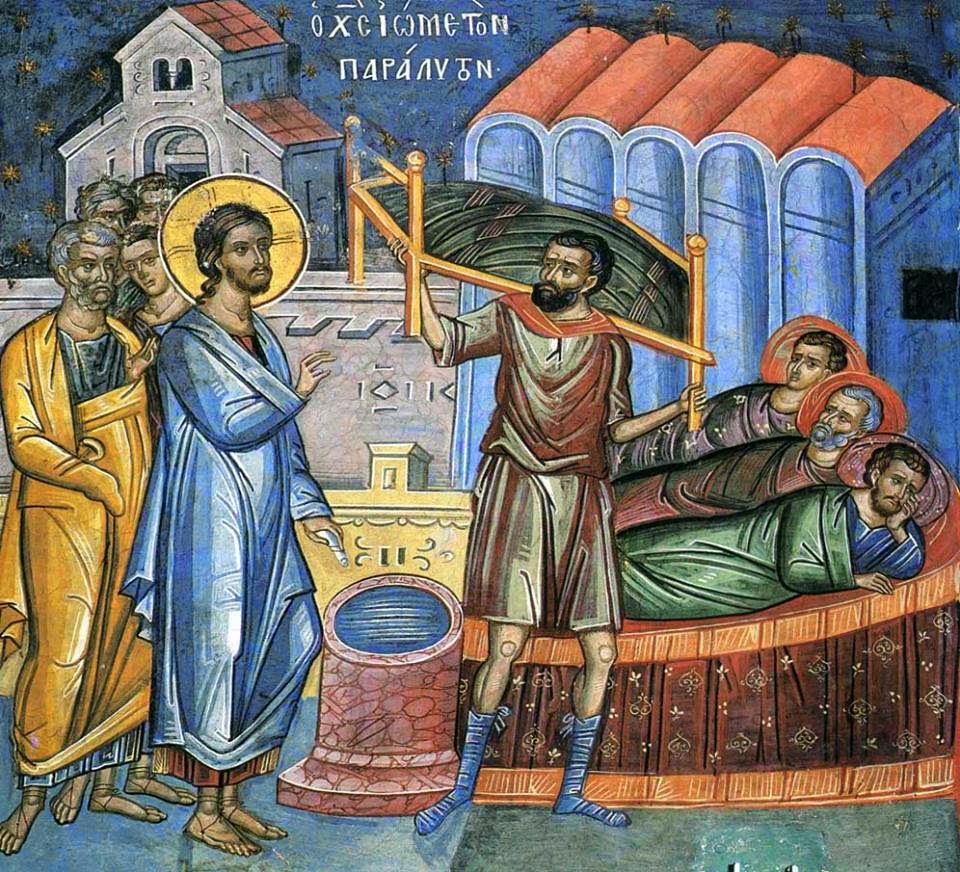
Sunday of the Paralytic
4th Sunday of Pascha
Acts 9:32-42
John 5:1-15
In the name of the Father and of the Son and of the Holy Spirit, Amen. Christ is risen! Indeed he is risen. Beloved in the Lord, “This is the first of sabbaths, king and Lord of days. The feast of feasts, holy day of holy days, on this day we bless Christ forevermore.” Why can’t we just get enough of it and move on, already? As I heard from one of our catechumens, whose mother said in surprise, “Didn’t they already have Easter?” I had another conversation with a homeschool mother and evangelical Christian from Ukraine who was helping me to spell “Воистину воскресе” on my cell phone. She was excited to share this moment with another Christian who gets it, who understands the power and significance of the resurrection. Then I said, “We’re just getting this 40-day party started.” She admitted, “You know, there really is something to that idea of feast days. Some members of my church argue that there shouldn’t be special days of remembrance— that we should remember the resurrection all year long.” But in not making any particular day sacred, I responded, they only succeed in making them all the same. It is just another form of the Great Lie, the Great Cosmic cover-up that the resurrection was all a hoax, a mirage, a collective result of wishful thinking on the part of Jesus’ disciples. The Church knows otherwise. And She gives us this 40-day period to celebrate the resurrection, but also to ponder the truth of it, to be convinced by what the book of Acts calls “many convincing proofs that He is alive.” (Acts 1:3)
The previous two Sundays were about events tied directly with Christ’s resurrection appearances. The Second Sunday of Pascha is called Thomas Sunday wherein we remember the disciple whose believing unbelief brought the first set of convincing proofs: St. Thomas touched the resurrected Lord’s side and felt the nail prints in His hands. He is here remembered not as Doubting Thomas, but perhaps a better moniker might be “Scientific Thomas” (He would fit right in here in scholarly New England). Then last Sunday, the Third Sunday of Pascha, we remember the Myrrh bearing Women who were the first to witness the resurrection and whose news seemed to the apostles as mere “idle tales”; nevertheless, because the Lord Himself appeared to the apostles and also to more than 500 at the same time (says St. Paul in I Corinthians 15), it was hard to chalk his disappearance up to a mere body snatching.
Now in this morning’s Gospel and Epistle we find several stories which at first might not seem related to Christ’s resurrection, at least not directly. From the Gospel, we hear the story of Christ’s healing of the man who had been paralyzed for 38 years who used to attempt his own healing at the Pool of Bethesda. When the Lord asked him if he wished to be healed, he expressed his wish, but claimed that there was no man who could help him down there to the healing water when the angel of the Lord troubled it. Jesus said to him, “Rise, take up your bed and walk.” And immediately, after thirty-eight years of faithful seeking, he was healed in that moment. So, what does this healing have to do with the resurrection? And why does the Lord also say not only to walk but to “pick up his bed” as well? I believe we get part of our answer by looking at the epistle which is from the Acts of the Apostles at the end of chapter 9. We read of another paralyzed man named Aeneas who was only eight years in that shape. St. Peter heals him in a way very similar to the Lord when he says, “Aeneas, Jesus Christ heals you; rise and make your bed.” Again, why not simply “Rise and walk.” Venerable Bede in his commentary writes:
When Peter had cured him of paralysis, he commanded him to rise at once and make his bed. Spiritually this informs us that whoever has received into his heart the firm foundation of faith will not only shake off the torpor in which he has been lying idle but will produce the good works in which he will be able to rest after his toil.
(quoted in Ancient Christian Commentary on the Scriptures, Vol. 5, p. 115)
Making his bed both for Aeneas and the unnamed man in today’s Gospel implies good works or what St. John the Baptist might have called “fruits worthy of repentance.” The act of picking up one’s bed of suffering means testifying publicly to God’s deliverance; when the Lord heals us, it is not just some private act, but one in which he calls the penitent to show forth his power to the world.
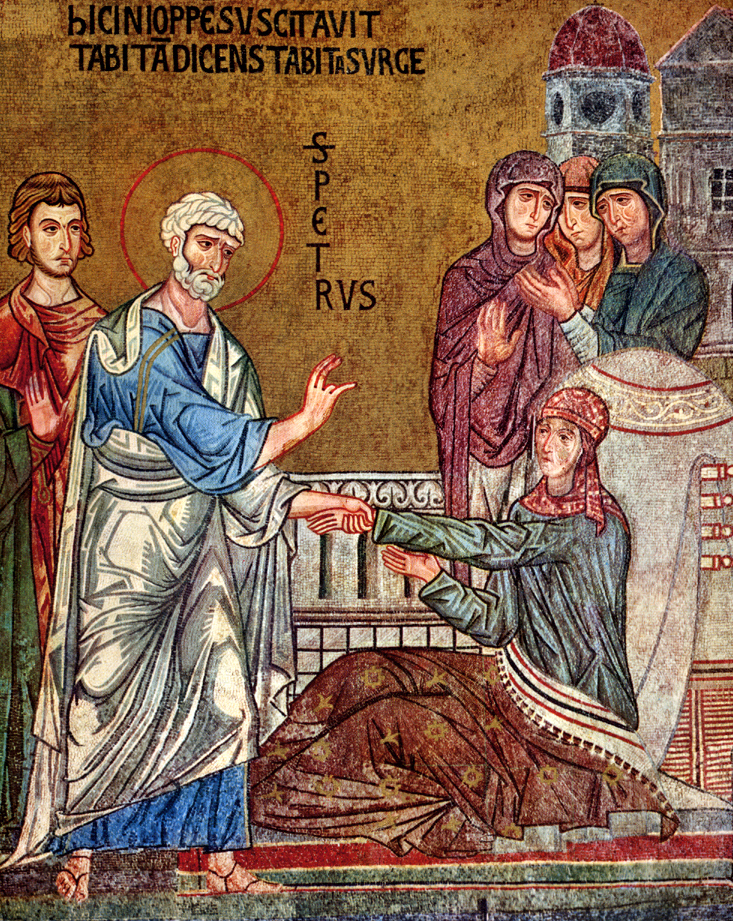
Finally in the reading from the Acts, we find a woman whom the Church remembers every Fourth Sunday of Pascha: St. Tabitha whose name means Dorcas, which translates to a gazelle whose vision is laser sharp. Her untimely death brings many of her close friends to St. Peter. Interestingly enough, they do not beg the apostle with words but, “… showed [him] the tunics and garments which Dorcas had made while she was with them.” (Acts 9:39) In other words, her acts/works spoke louder than her words. St. Peter also commands her to arise, and like Aeneas and the paralytic at Bethesda, she wakes up and rises as if from sleep.
These three miracles are interconnected precisely at this point. When the Lord Jesus Christ heals either directly or through one of his disciples, he asks us to arise, either literally or figuratively. As Venerable Bede comments on the healing of Aeneas:
This Aeneas signifies the ailing human race at first weakened by pleasure but healed by the work and words of the apostles…. Anyone who embraces the unstable joys of the present is as though flattened upon his bed, devoid of energy…. For the bed is that sluggishness in which the sick and weak soul takes its rest in the delights of the body that is in all worldly pleasures.
(ibid., Vol. 5, p. 115)
In other words, we too are like the paralytic and even the dead woman Tabitha: We lie prone in the idleness of our own sinfulness, our own indolence, our own lazy habits and poor judgment. Yet the Great Physician of Our Soul and Body condescends to our indolence and commands us not only to rise, but to pick up the bed of our suffering, to carry the proof of our deliverance, lest we forget and lapse back into our old ways of being.
The great songwriter Keith Green rebukes us in our tendency not to rise, not to pick up our bed, but to lay back in its comfort. He sings:
The world is sleeping in the dark
But the church just can’t fight
‘Cause she’s asleep in the light
How can you be so dead
When you’ve been so well fed?
Jesus rose from the grave
But you, you can’t even get out of Bed.
So, on this Sunday of the Paralytic, “let us arise in the deep dawn and instead of myrrh, offer praise to the Master and we shall see Christ the Sun of righteousness, who causes light to dawn for all.” (Ode 5- Paschal Canon) Christ is risen!!! Truly He is risen!!!
 Like Mendicant Monks...
Beautifully written! The Sunday of the Paralytic really changed my perspective. The describing of faith for 38 years really pushed me to have faith, despite my own sufferings and pain. A true inspiration and reminder that Christ will deliver, despite it all.