Russian Babas: Unsung Heroes of the Church

July 4/17, 2012,  Royal Martyrs: Tsar-Martyr Nicholas, Tsaritsa Alexandra, Royal Crown Prince Alexis, Grand Duchesses Olga, Maria, Tatiana & Anastasia

Our family’s name day! We attend a local parish for Liturgy in the morning and spend the rest of the day close to home. The following is the last post written on Divyevo. Tomorrow we turn our attention towards leaving to Sochi on the Black Sea, site of the upcoming 2014 winter Olympics.

Saturday, July 1/14, 2012,  Ss. Cosmas & Damian

On the second day in Divyevo, we attend the second of two morning Liturgies at 8am (the first one is at 5:30am). After breaking our fast at one of the monastery trapezas (something like a little coffeehouse) and eating a lunch offered to all the pilgrims, my daughter and I join a group of babas (Russian grandmothers) for a small obedience. We helped separate the wheat from the chaff, a very fitting duty, straight from the Gospels. Continue reading

Learning a New Language and Culture

Some people have asked what it is like to learn another language or culture like the Russian language. I am not the best person to ask as I have only become assimilated enough to carry on a broken conversation for about 5-10 minutes by myself without my wife’s assistance. But still, I feel like there are a few good things to expect while planning to come to Russia.

The language is the first big challenge, but it is not as insurmountable as it might seem at first. Before considering any pilgrimage, a person has to reach deep within and ask, “Why am I going on this pilgrimage?” It is a question which ought not to be confused with the more selfish one, “What is in it for me?” since you are going on pilgrimage for others as much as for yourself, to intercede to the saints on their behalf.

When first learning the language, there are many helpful programs to listen to. Most recommend Rosetta Stone, but I personally like the Pimsleur Language Program, available in toto at the local library (I recommend the complete course in three parts, not the quick and easy versions). I listened to all 90 lessons one summer that we were in Russia for three months and it helped me break the sound barrier: that uncomfortable silence when someone asks a basic question in Russian and you don’t have anything to say for yourself.

At this point, someone might ask, “Why go to that trouble if you have someone to translate into English?” Certainly, this makes it easier for you the English speaker, but two things are lost in translation: 1) The directness of speaking to another person face to face, however faltering, without the help of an interpreter, and 2) The full attention of the person who agrees to translate. Just because someone knows how to speak two languages fluently does not necessarily mean they are good at translating from one into another; it is a skill all its own, and a worthwhile skill, but it requires work which the single-language speaker often takes for granted.

I remember the first time I met someone in Russia that I wanted desperately to speak to directly. Each one of the few words I knew were so pregnant with meaning. How surprised I am still by how much meaning can be packed into so few words. Like the apostle Paul who preferred to speak 5 intelligible words than 10,000 in an unknown, un-interpreted tongue, I think more is communicated by what is left unsaid than by what is said. The apostle John reminds us in his first epistle that people will know we are Christians by our love, not our words, and thankfully love is a universally understood language, spoken primarily through the eyes directly to the heart.

So, once you have mastered a battery of basic words and phrases, the second challenge is a much harder one and much more nuanced. It is the realization that everything you want to say and do in English doesn’t always translate well into Russian no matter what words you use. A good example is what we each consider the mark of highest praise for another person. For America, it might be a person’s sense of humor or that they know how to have a good time. For a Russian, someone who behaves like this at the outset of meeting him/her will make the other person conclude that he/she is a little crazy. For a Russian the highest note of praise is usually another person’s degree of seriousness, while the average American might want a very serious person to lighten up a bit before getting to know them better. In so many of these cultural comparisons, it is tempting to cast judgment in either direction, but I believe the Lord would have us be multi-cultural which means in this case refraining from judging the differences as better or worse. For us who are learning, they are just different; to make a right judgment, we really need more information or background.

Vive la difference as the French say. May our differences not only be allowed to exist, but may they teach us to suspend judgment until we expand the horizon of our understanding.

Arriving at Divyevo

Monday, July 3/16, 2012, M. Hyacinth

Today is our recovery day and a chance to catch up on emails and blog posts. Arrived early morning to Moscow and have been in the apartment ever since, just resting. The following is a first post of our trip to Divyevo:

Friday, June 30/July 13, 2012,  Synaxis of the 12 Apostles

We arrive early morning (5:30am) by overnight train and take a bus to Divyevo. On the way, we take a triple dip in one of the four holy springs surrounding St. Seraphim’s village of Divyevo. When we check in at our hotel at 8am, it feels already like the day has been spent.

Traveling as pilgrims with two young girls is a bit of an experiment for us. The hotel we are staying at for the next couple of nights is comfortable enough, but we travel all in one suitcase without the usual toys and games. One whole bag is dedicated to food and provisions for tea, as you never know on pilgrimage where and when to eat the next meal. So far our little pilgrims are doing well with an afternoon nap that we finally talked them into.

Almost finished with the St. Seraphim life, but I have not really been here long enough for a strong impression to form. We heard one general introduction to the monastery and its life, how St. Seraphim was invited by the Abbess Alexandra to be their father confessor and protector. Also, there is lots of talk about how Divyevo was chosen as the 4th place on earth especially dear to the Mother of God, the Virgin Mary (the other three are Iberia (Georgia), Mount Athos, and Kiev). It makes me wonder why Jerusalem was not included, but perhaps it is because the Holy Land is a given, in a category all its own.

Still, it seems significant that two of the four places are in Mother Rus (Ukraine was originally part of the ancient kingdom). Questions still linger for me about why she chose Divyevo and why St. Seraphim is so special especially for Russians. I have my ideas, but we will see how the pilgrimage unfolds.

Eating Manna at the Monastery

Image

July 2/15, 2012, Placing of the Honorable Robe of the Most Holy Theotokos at Blachernae (5th cent.)

I always feel uncomfortable when someone asks about my favorite food in Russia, for like the Israelites in the desert, it is not so much about what’s on the menu as the relationship with the Provider. Manna, what the Israelites ate in the desert, literally means “What is it?” But a better question than this is, “Who gave it?” For in both cases of manna and monastery food, they clearly come from heaven.

At the Divyevo trapeza, the free one offered to all pilgrims, the menu never really changes: soup, bread, tea, and that ever useful, multi-purpose, everywhere present KASHA. True confession that I have never really liked kasha, probably because of its plainness. I probably have asked the disdainful question of the Israelites about it as well, “Just what exactly is it?” In America, its humility places it on the bottom of the breakfast menu. We really only know one kind of kasha, oatmeal, and no one but a health nut ever really orders it. Yet there is something about kasha which makes Russians love it, for among other things, it is ordinary food which gives strength and endurance to pilgrims.

Food, reminds the apostle Paul, does not bring us near to God. We are no better if we do not eat, or if we do eat (I Cor. 8:8). It is rather the setting or context that can help us in our salvation. Our family has never had a meal in a monastery that did not taste delicious because of how it was consecrated by love for God and prayer. The lives of the desert fathers and the record of the deplorable things they consumed testifies that God can indeed turn stones into bread.

While we in America obsess over the right restaurant or the perfect gourmet experience, we miss the point. Kasha, like the ancient Manna, directs our attention away from gourmet obsessions toward thankfulness for whatever God provides.

In Kavala for the Feast of Ss. Peter & Paul

Dear Friends,

Since we are getting ready to depart for Divyevo tomorrow, this will be my last post until next Monday. Hope to come back with lots of good bits about St. Seraphim. Some of you have asked about language learning, so I might do a post on that.

In the mean time, here is something I emailed last year for tomorrow’s feast of Ss. Peter and Paul when I was in Greece celebrating on the New Calendar. It was by far my most memorable time in Greece and favorite post, so if you haven’t yet read it, I hope you will enjoy! See you all again on July 16!

Tuesday, June 28, 2011

This slideshow requires JavaScript.

We arrive in Kavala on the Eve of the Feast of Ss. Peter and Paul (N.S.), the very place where the apostle Paul first set foot in Europe and catechized his first European convert, Lydia the purple seller from Thyatira. The vigil begins in the Cathedral dedicated to St. Paul in the heart of the city… begins here, but moves elsewhere.

The moment is beyond poetic, and I am strangely patriotic. Yes, that’s right, the WASP (or rather WASO) with not a drop of Greek blood in his veins feels pride for the motherland. Tonight, everyone here at the Cathedral is a dual citizen, a citizen of Greece but also of the kingdom of heaven. In this country currently rocked by economic and political crises, it is almost as if the land is trying to be born anew at this moment in which Greek and Byzantine flag fly over the Cathedral square, born into a more perfect union.

British journalist and novelist G.K. Chesterton once said of America that she is a nation with the soul of a Church. Tonight, Greece reveals herself as a nation whose body, soul, and spirit all belong to the Church. Whenever she is separated from that life-giving unity whether by corrupt politicians, greedy economic schemes, or secular ideologies she begins to die spiritually. But tonight, on this great Feast of Ss. Peter & Paul, bodies, souls, and spirits all are present in great numbers awaiting a special experiment in liturgical celebration.

As I said before, the vigil of the feast only begins at St. Paul’s Cathedral for vespers. Then at the end of Vespers, all of the people fill the streets and process to the actual site of St. Paul’s first landing in Kavala, a distance of 1-2 miles. This experiment is a return to stational liturgies, a way of celebrating the divine services by praying one piece at a time at different successive churches with a procession between each station.

It was the standard modus operandi in Constantinople 1000 years ago, but, as scholars tell us, gradually the ethos of liturgy became more and more contracted as the empire suffered loss and was eventually overcome by Islam. The once ecstatic (literally “moving outwards”) and dynamic work of the people became more and more withdrawn and privatized. The Great Entry in the Liturgy of St. John Chrysostom that once spanned the whole city of Constantinople has in today’s practice been reduced to a u-turn within the confines of the local sanctuary.

But tonight, the Church returns to her more apostolic and universal roots. In the procession, soldiers, firefighters, girl scouts, and colorful folk dancers all gather around the Klobouklion of St. Paul along with the Bishops, clergy, and most importantly, the faithful Christians assembled. It is more than a civic parade, more than a nice festival with a little religion sprinkled on top. It is unequivocally a work of the people, a united effort of praise to God in Holy Trinity, Father, Son, and Holy Spirit.

Nothing I have seen in America can compare to it. I have grown up with very reverent parades honoring fallen comrades and giving God his due, but it is never quite as full and complete. Always the idea of American Civic Religion muddles the power of the cross and generalizes Christ right out of existence; the minister is invited to offer an invocation at such events, but to be sure, not to say anything specifically Christian. Tonight, the Metropolitan of Kavala and two other bishops lead the civic leaders, armed forces, police, etc. and not the other way around. Christ is not only center-stage, but preached in a way so public as to cause scandal in some places of America.

To those on the New Calendar, Chronia Pola, Blessed Feast! Greetings on this glorious and apostolic day, and pray for Mother Greece, that she may be known more for events like this night and less for the ongoing economic and political crises.

Untamed Virgin Forest

St. Serpahim of Sarov Feeds a Wild BearJune 27/July 10, 2012

St. Sampson the Hospitable

When I first started teaching at St. Herman of Alaska Christian School in Boston, I remember the headmaster charging me with the duty to impart to the students a sense of untouched virgin forest as far as the eye could see; for this is what the first settlers to America witnessed upon arrival to those shores. They witnessed it and then quickly went about the process of taming this wild country. The English need for gardens, finished houses, and walls to guard them all would have none of this un-ploughed jungle. Later ideas of industrial progress turned domesticating nature into a right and almost a virtue.

While the Russian people have done their share over the centuries of clearing lands for farmhouses and villages, their attitude towards wild, untamed forest has been generally quite different from America. Part of this must have something to do with owning 1/6 of the world’s landmass. Trimming the verge or keeping the lawn mowed is a little overwhelming when one considers this immensity. Still, I think there is something else in the Russian relationship with the natural world which extends beyond the needs of practical stewardship.

I am rereading the life of St. Seraphim of Sarov in our preparation to travel to Divyevo on Thursday. Like many ascetics of the deserts of old, his struggle in the wilderness towards repentance brought him into intimate contact with bears and other wild creatures that usually fight or flee at the sight of a human being. But the reason for his popularity among Russians and many converts in America (who take on his name) has to do with something particularly Russian. When monks like Seraphim wanted to flee the world to pray and draw closer to God, they didn’t have the isolation of the Egyptian desert. Instead of sand, they invented a northern thebaid: the dense and impenetrable Russian forest. The Russian ascetic’s dream, it turns out, is similar to the American pioneer who was disenchanted with the drab, colorless life of industrial cities. Both wanted to find a home where wild things and the human spirit could roam.

We visited today one of the last undeveloped, deep forested  areas of Moscow called Bitsevsky Les. While it can hardly be called “untouched”, its proximity to public transportation makes it a great place for a chance encounter with one of St. Seraphim’s forest friends. And though our forest wasn’t quite virginal, it still testifies to the majesty of its Maker.

An Explosion of Extremes

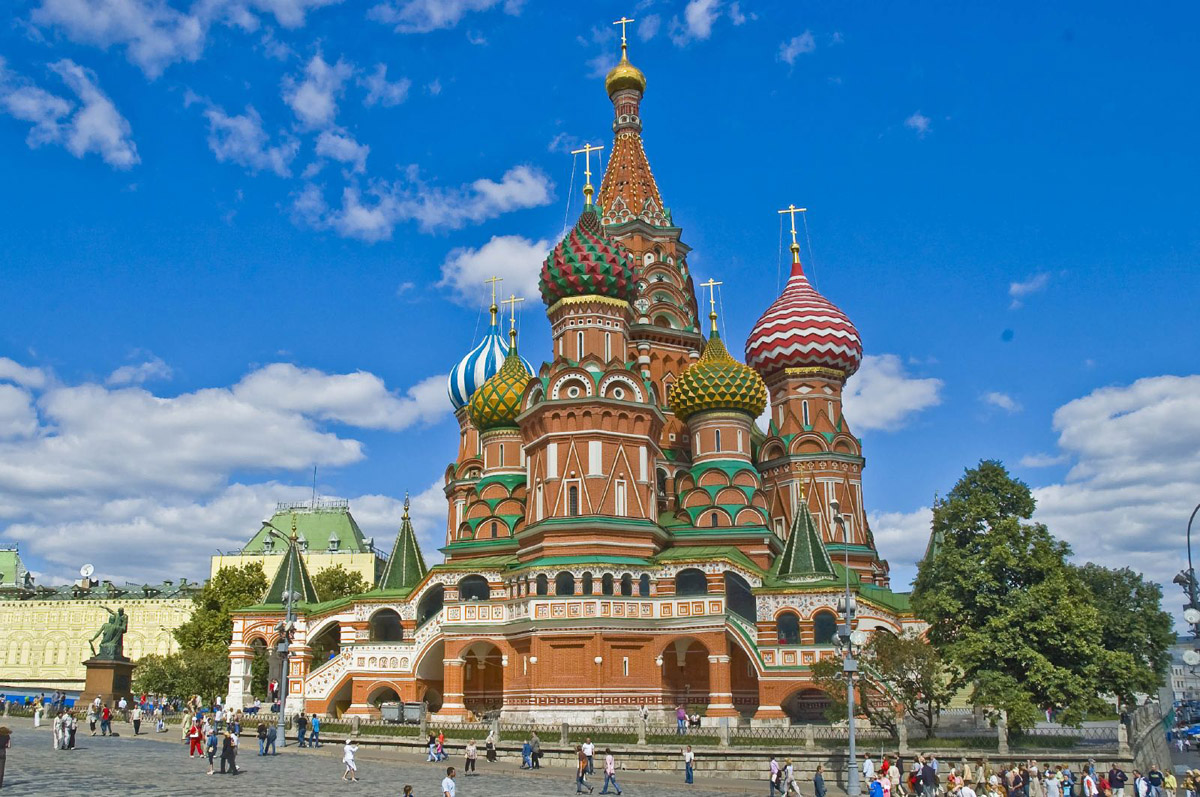
St. Basil’s Cathedral, Red Square

June 26/July 9, 2012

St. David of Thessalonica

We finally take a proper excursion into the center of the city to the well-known and much celebrated Red Square. Somehow, a visitor does not truly feel they have arrived in Russia until visiting this center of national gravity. Beyond being a great place for photo opportunities, it establishes for the tourist/pilgrim the identity of the place to which he/she has journeyed.

Russians have an obsession with things really, really BIG, or really, really SMALL, and not much patience for settling matters in the compromised middle. If anything is worth doing, it is worth going all the way, or why bother? The iconic St. Basil’s Cathedral in Red Square is a great example of this love of extremes. Built by Tsar Ivan the Terrible, it is an explosion of architectural styles and colors. The multiple towering domes shelter a series of surprisingly small, separate chapels on the inside. It is majesty in miniature.

It all reminds me of G.K. Chesterton’s definition of orthodox Christianity in his classic apology Orthodoxy: The Romance of Faith (small “o”, as he himself was a convert to Roman Catholicism). Chesterton, also no lover of gray compromise, was a colorful figure from the late 19th and early 20th century who has been influential in bringing many atheists (including C.S. Lewis) to faith by his penchant for paradox. He says that what Christians aim at in their definition of orthodoxy is not a mean between two extremes, the dirty gray that results from mixing black and white. No, Christian orthodoxy would have both extremes “…at the top of their energy: Love and wrath fully burning.”

When I look at St. Basil’s, I think of this explosion of extremes. There is nothing tamed or compromised about this tribute to faith. So, while we tourists attempt to tame it into a postcard, Kodak moment, its towering domes capture the essence of faith in Jesus Christ, the Lion of Judah, who cannot be tamed into a compliant house cat.

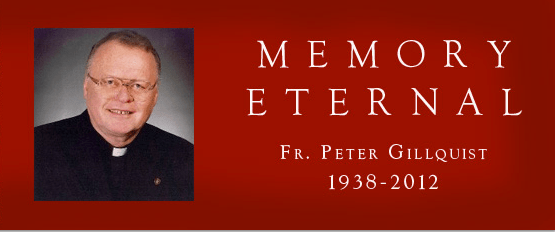
Memory Eternal: Fr. Peter E. Gillquist

peter

Fr. Peter Gillquist was the first Orthodox priest I ever met, and his book Becoming Orthodox was the first book I ever read on the Orthodox Church. He came to my campus and introduced me to a Church I never heard about, though that time in my life I had been to 15 different churches, and like the Samaritan woman, the church I then was with was not really “my church”. Fr. Peter revealed to me my church, the Church of Jesus Christ, and the Holy Apostles, and not a day of life goes by that I don’t bless the memory of this great man and priest of God.

Memory Eternal! Vechnaya Pamyat!

Sunday Tea with Batiushka

Sunday, June 25/July 8, 2012

St. Febronia

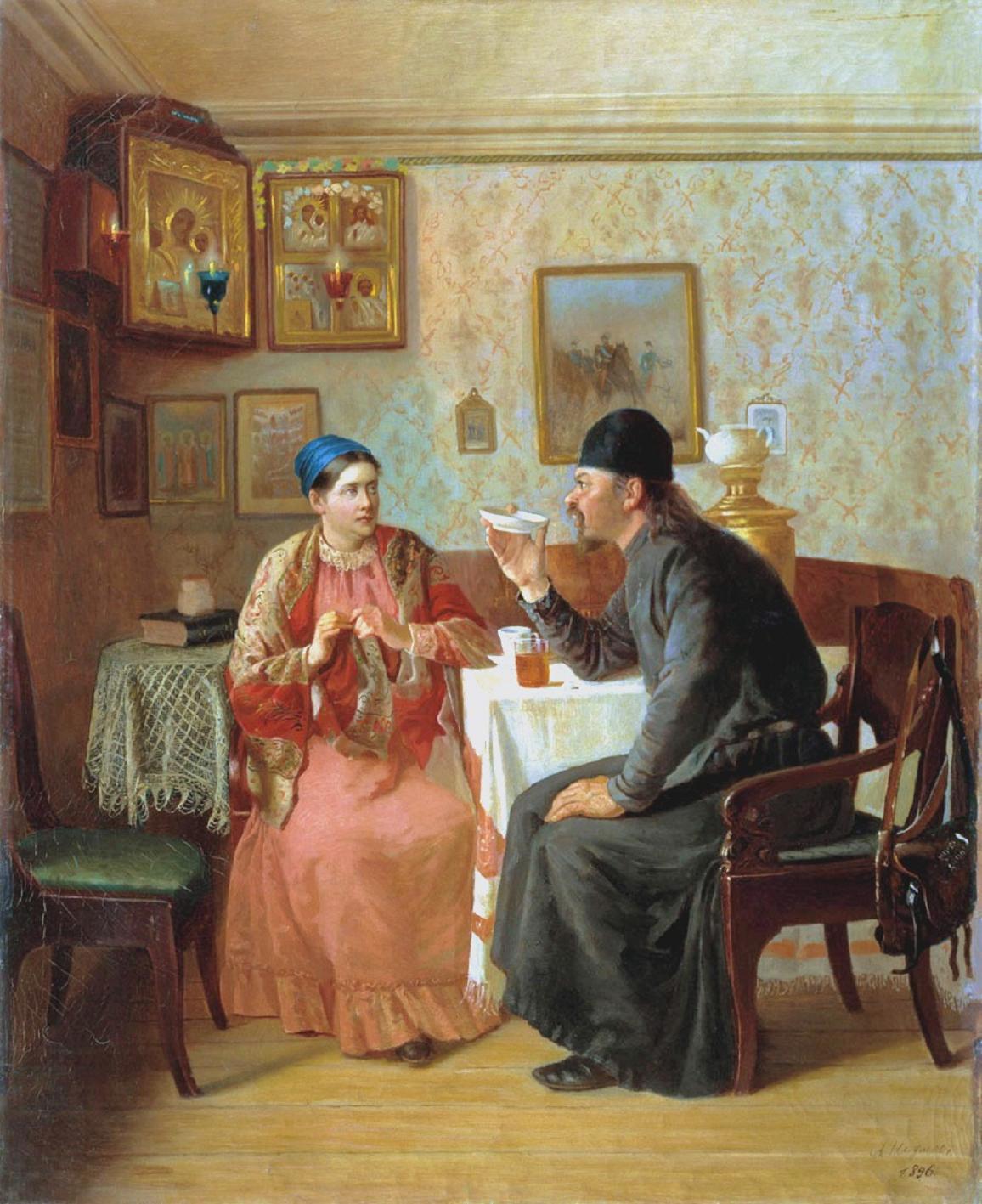
Aleksei Naumov “Drinking-Tea”- 1896

In Greece, they have a saying, “Everything is possible, and everything is impossible.” In Russia, at times it seems that only the latter is true. Yesterday, we spent nearly the entire day attempting to set up a wireless connection for our laptop to no avail. But as I said in a previous post, these difficulties are gifts from God so that we may rely more on His power and less on our strength or the strength of human systems.

Today is Sunday, Voskresenie, which literally means “the Day of Resurrection.” The atmosphere all over Moscow is qualitatively different on the Lord’s day, even for non-believers or those who don’t attend church for the morning Liturgy. Streets are relatively free from traffic and a large portion of people on the street are all headed to church. It’s refreshing to be in an Orthodox country in which almost every church you pass by is of the same faith. This unity trickles down to the smallest of details, so that even the food in the grocery store is marked as “fasting appropriate.”

In the afternoon, I have my first experience in Russia with a trapeza (a sit-down meal in which the head directs the conversation or reading in a spiritual way) at our apartment attended by a priest traveling through Moscow from Ulan Ude. I have been to larger monastery trapezas, but this time it was only Fr. Alexei, an igumen (head) of a monastery in eastern Siberia, and our family in attendance. What a treat to speak to a batiushka (Russian diminutive for priest) from a remote southeast corner of the motherland! Tales abounded of overcoming bureaucracies to bring much needed improvements to local villages and of bringing the faith to areas with many nominal Orthodox and few churches to serve them. Truly, the situation here in the capital, with a church on almost every corner, is not yet so in the outlying provinces where they are just beginning to rebuild after the fall of communism in 1991.

Still, the overall tone in the Orthodox Church in Russia is revival and renewal, with new churches being built constantly, and it is a glorious thing to behold.

Toasting the Company of the Saints

Icon of All Saints

Thursday, June 22/July 5, 2012 HM Eusebius

We arrived yesterday evening on the 4th of July at Domodedova Airport to the other great “land of the free and home of the brave”, this thousand-year-plus old home of saints and those aspiring to be so, Mother Russia. I have decided to launch this blog instead of merely emailing our travel reflections. It worked last summer to post my trip to Greece and Turkey as a series of emails and then finally compile them into one Pilgrimage Memory Book, available here. But email is limited in the sense that the text and pictures cannot live close enough to one another, and so much of what I write is illustrated in particular photographs. God has gifted our family so greatly with these summer trips to Russia (this is my forth, and our family’s fifth); it would be selfish to keep all of these blessings to ourselves.

Even if we do nothing more than stay in Moscow, there is so much benefit gained by living for a while in another culture. It forces us out of our comfortable patterns and presses us to rely more readily on help from God as we seek to cope with the adjustment. Crossing that airport checkpoint means crossing into another world in which more than just the language is different. To open, I will try to focus on what is pleasantly different and leave the un-pleasantries to hopefully transform me into a better man.

One pleasant cultural difference in Russia is the ease with which people visit one another. In our first 24 hours, we have been greeted by not less than three unexpected guests on two separate occasions. Of course, each occasion warranted the pulling out of several courses: always first a toast after the prayer to the meeting or whatever the occasion, then soup, then salad, an assortment of nuts, salted fish, potatoes, more soup, more salad; then savory things are withdrawn to make room for the dainties that accompany the tea: crispy, donut-like lee-pyoshki, different kinds of jam, fresh peaches and cherries, and a bowl full of hard candy. It’s no wonder Russians in America are unimpressed by our Thanksgiving holiday. For a guest in Russia, every meal is like a Thanksgiving meal, even the ones offered during a fasting period (the Orthodox Church is now in the middle of the Apostle’s Fast in which the faithful abstain from all meat except fish and all dairy and eggs).

But I digress on food which Russians don’t really discuss much at the table like we Americans. No, the point of the meal is the company gathered, and though the Russians have borrowed the English word (companiye in Russian) to describe the experience, I am convinced they have a much deeper understanding of its meaning. The battery of toasts offered during the course of each meal makes this point plain. The first toast will always be for the reason of gathering: If it is a birthday, congratulations to the person celebrating it; if it is an anniversary, congratulations to the couple celebrating it, etc. If there is nothing special anyone gathered can think of, then the first toast za fstreture (“to the meeting”) offers thanks to God for the providential opportunity of just sitting across the table from one another, face to face, and talking.

What follows during the meal varies, but it is usually based on the course of conversation. For instance, at a birthday, it is natural after congratulating the birthday boy/girl to start talking about the couple whose love brought this little one/big one into the world. So, a follow-up toast will be to the parents and/or grandparents. Toasts following this tend to be for other relatives and friends that have figured prominently in the honored guest’s life, and it is only toward the end of the meal when more abstract, general toasts are made for brotherhood, peace and love. I remember when I first learned enough Russian to offer a meager something of my own at the table. I was tempted to rhapsodize eloquently on one of my favorite philosophical subjects when my wife would inevitably nudge me (or refuse to translate my English ramblings) because my toast was not directed to a person or to the company gathered.

This brings me to our beautiful Orthodox theology, as all good culture engenders good theology. “My neighbor [company] is my salvation,” says many noted, contemporary elders of the Church. We cannot find Jesus Christ completely on our own, in pursuit of some idle curiosity, or once we have found Him, sustain his company without others. Rather, the Lord prays, “Make them one, Father, as you and I are one.” (John 17) As we strive for unity in Him, we also grow closer one to another in a company of sanctity that stretches beyond the present in both directions— past and future. The great apostle Paul reflects on this mystery in a passage we read on the Sunday of All Saints, Hebrews 11:33-12:2, in which we commemorate all the vast company of martyrs, confessors, and every righteous man or woman made perfect in faith. But the conclusion of this amazing commemoration is the most humbling, and it speaks to the future direction of the Lord’s plan of salvation: That as great as this company of saints is, they received not the promise. God having provided some better thing for us [in the present], that they without us should not be made perfect. (Hebrews 11:39, 40)

Really? Something better or greater than being sawn asunder and yet alive? Greater than living through a furnace heated seven times hotter than usual? Greater than all these things performed by men and women of whom the world was not worthy? Yes. The Lord intends that with the example and active intercession of these saints who have gone before, we might do even greater things than these. O Lord, may we immerse ourselves in the lives of the saints, so that we not look in judgment and isolation at the lives of those around us. In their great company, may we not take for granted the neighbor you have given to accompany us in our path of salvation. Unto Thee be glory, forever and ever, AMEN.