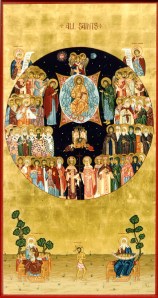
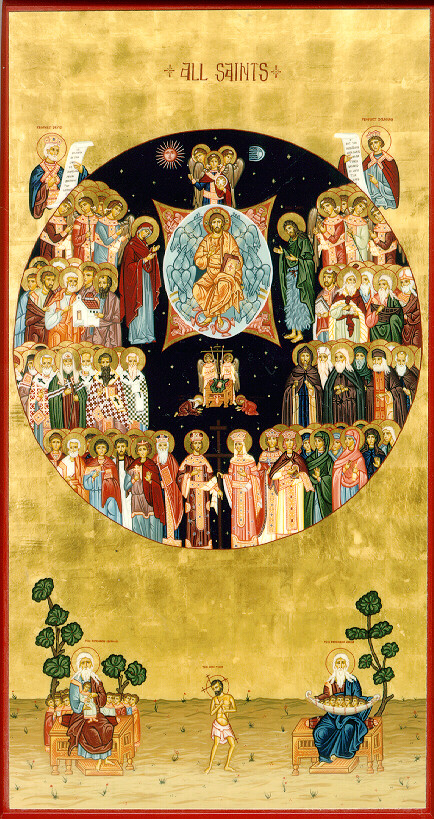
Icon of All Saints
Thursday, June 22/July 5, 2012 HM Eusebius
We arrived yesterday evening on the 4th of July at Domodedova Airport to the other great “land of the free and home of the brave”, this thousand-year-plus old home of saints and those aspiring to be so, Mother Russia. I have decided to launch this blog instead of merely emailing our travel reflections. It worked last summer to post my trip to Greece and Turkey as a series of emails and then finally compile them into one Pilgrimage Memory Book, available here. But email is limited in the sense that the text and pictures cannot live close enough to one another, and so much of what I write is illustrated in particular photographs. God has gifted our family so greatly with these summer trips to Russia (this is my forth, and our family’s fifth); it would be selfish to keep all of these blessings to ourselves.
Even if we do nothing more than stay in Moscow, there is so much benefit gained by living for a while in another culture. It forces us out of our comfortable patterns and presses us to rely more readily on help from God as we seek to cope with the adjustment. Crossing that airport checkpoint means crossing into another world in which more than just the language is different. To open, I will try to focus on what is pleasantly different and leave the un-pleasantries to hopefully transform me into a better man.
One pleasant cultural difference in Russia is the ease with which people visit one another. In our first 24 hours, we have been greeted by not less than three unexpected guests on two separate occasions. Of course, each occasion warranted the pulling out of several courses: always first a toast after the prayer to the meeting or whatever the occasion, then soup, then salad, an assortment of nuts, salted fish, potatoes, more soup, more salad; then savory things are withdrawn to make room for the dainties that accompany the tea: crispy, donut-like lee-pyoshki, different kinds of jam, fresh peaches and cherries, and a bowl full of hard candy. It’s no wonder Russians in America are unimpressed by our Thanksgiving holiday. For a guest in Russia, every meal is like a Thanksgiving meal, even the ones offered during a fasting period (the Orthodox Church is now in the middle of the Apostle’s Fast in which the faithful abstain from all meat except fish and all dairy and eggs).
But I digress on food which Russians don’t really discuss much at the table like we Americans. No, the point of the meal is the company gathered, and though the Russians have borrowed the English word (companiye in Russian) to describe the experience, I am convinced they have a much deeper understanding of its meaning. The battery of toasts offered during the course of each meal makes this point plain. The first toast will always be for the reason of gathering: If it is a birthday, congratulations to the person celebrating it; if it is an anniversary, congratulations to the couple celebrating it, etc. If there is nothing special anyone gathered can think of, then the first toast za fstreture (“to the meeting”) offers thanks to God for the providential opportunity of just sitting across the table from one another, face to face, and talking.
What follows during the meal varies, but it is usually based on the course of conversation. For instance, at a birthday, it is natural after congratulating the birthday boy/girl to start talking about the couple whose love brought this little one/big one into the world. So, a follow-up toast will be to the parents and/or grandparents. Toasts following this tend to be for other relatives and friends that have figured prominently in the honored guest’s life, and it is only toward the end of the meal when more abstract, general toasts are made for brotherhood, peace and love. I remember when I first learned enough Russian to offer a meager something of my own at the table. I was tempted to rhapsodize eloquently on one of my favorite philosophical subjects when my wife would inevitably nudge me (or refuse to translate my English ramblings) because my toast was not directed to a person or to the company gathered.
This brings me to our beautiful Orthodox theology, as all good culture engenders good theology. “My neighbor [company] is my salvation,” says many noted, contemporary elders of the Church. We cannot find Jesus Christ completely on our own, in pursuit of some idle curiosity, or once we have found Him, sustain his company without others. Rather, the Lord prays, “Make them one, Father, as you and I are one.” (John 17) As we strive for unity in Him, we also grow closer one to another in a company of sanctity that stretches beyond the present in both directions— past and future. The great apostle Paul reflects on this mystery in a passage we read on the Sunday of All Saints, Hebrews 11:33-12:2, in which we commemorate all the vast company of martyrs, confessors, and every righteous man or woman made perfect in faith. But the conclusion of this amazing commemoration is the most humbling, and it speaks to the future direction of the Lord’s plan of salvation: That as great as this company of saints is, they received not the promise. God having provided some better thing for us [in the present], that they without us should not be made perfect. (Hebrews 11:39, 40)
Really? Something better or greater than being sawn asunder and yet alive? Greater than living through a furnace heated seven times hotter than usual? Greater than all these things performed by men and women of whom the world was not worthy? Yes. The Lord intends that with the example and active intercession of these saints who have gone before, we might do even greater things than these. O Lord, may we immerse ourselves in the lives of the saints, so that we not look in judgment and isolation at the lives of those around us. In their great company, may we not take for granted the neighbor you have given to accompany us in our path of salvation. Unto Thee be glory, forever and ever, AMEN.

 I had an enlightened conversation the other day with the young daughter of my wife’s best friend in Moscow. In her young age of only 15, she has had the great fortune of living abroad with grandparents in Canada for half a year, and so she has some perspective on her own motherland. Since all of her family members are practicing artists, it is not surprising that our discussion revolved around art. But art for a Russian means something different than for an American, or rather the people have a different relationship to art. For a Russian, paintings are not simply objects which are consigned to museums, available for an elite segment of society that can afford the time and money to develop a taste for “that sort of thing.” They are rather like windows to the soul of every Russian, companions to them along the way, and just as everywhere present in society as icons are ever-present in the churches. Continue reading

 Arrived yesterday to Moscow for our family’s seventh time in the land of




 Like Mendicant Monks...