When Things Don’t Work

I have told you these things, so that in me you may have peace. In this world you will have trouble. But take heart! I have overcome the world. (John 16:33)

An avid reader of this blog several years ago implored me to tell a few of the difficulties of living abroad with a large young family. While I do not wish to complain about our gracious host country, I also do not want to paint all of our experiences with an overly rosy outlook. Truth be told, it is often quite hard, especially when things don’t work out the way they are planned. And especially for us Americans who just expect everything as a rule to be safe, expedient, and convenient, a paradoxical place like Russia can become quite unnerving. Continue reading

From Murder to Mercy

IMG_5512Now listen, you rich people, weep and wail because of the misery that is coming on you. Your wealth has rotted, and moths have eaten your clothes. Your gold and silver are corroded. Their corrosion will testify against you and eat your flesh like fire. You have hoarded wealth in the last days. Look! The wages you failed to pay the workers who mowed your fields are crying out against you. The cries of the harvesters have reached the ears of the Lord Almighty. You have lived on earth in luxury and self-indulgence. You have fattened yourselves in the day of slaughter. You have condemned and murdered the innocent one, who was not opposing you.

Epistle of Apostle James Chapter 5

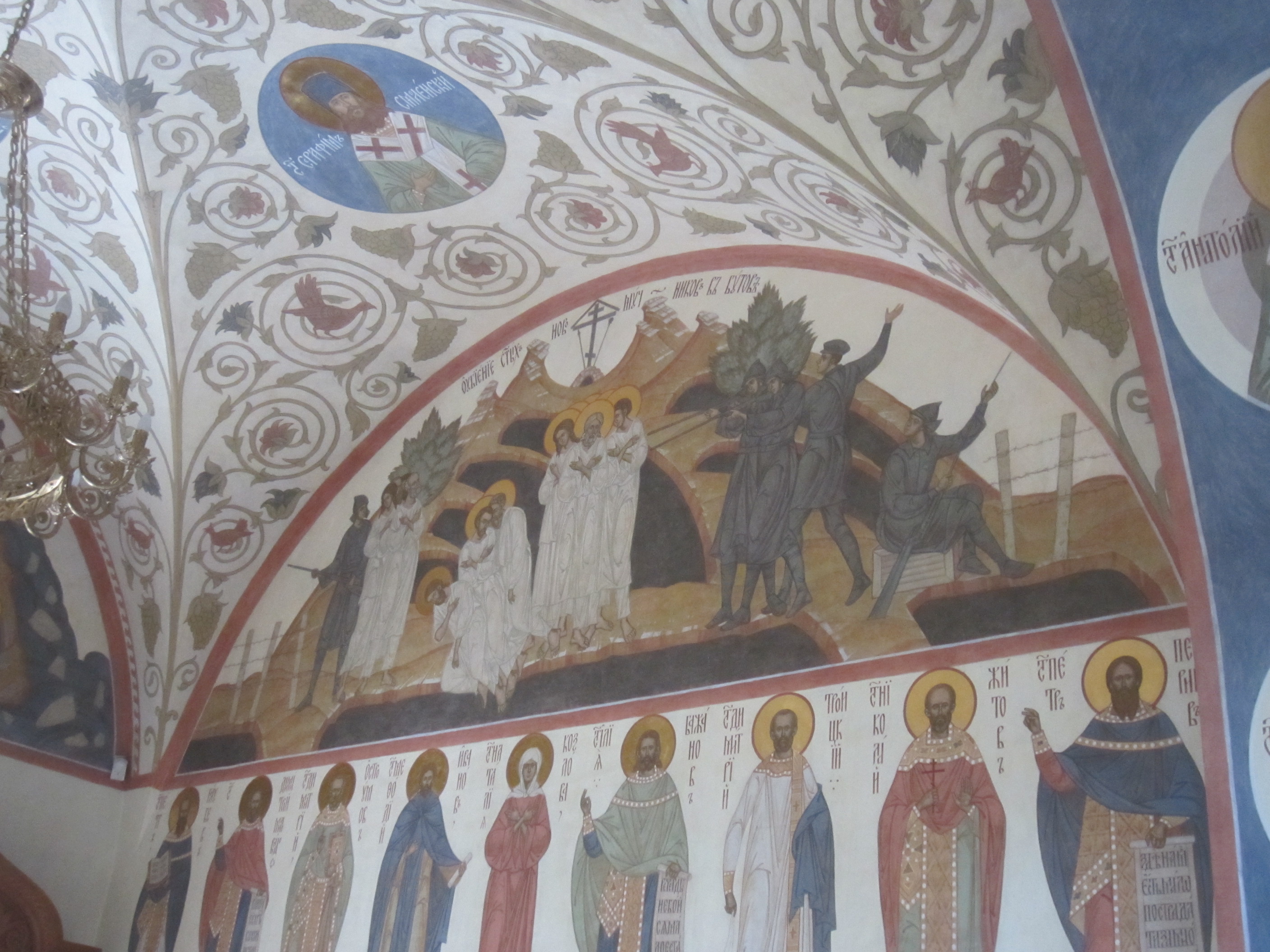
The senseless murder of innocents has often in history followed godless greed and unholy desire for personal gain. Midway through the 20th century experiment of atheist communism in Russia, Joseph Stalin felt the need to purify the system and find new sources of blame for his failing policies. Finding no blame in himself, he and his minions sought secretly and indiscriminately to purge undesired members of society in numbers before unimagined. Continue reading

An Underground Museum

I had an enlightened conversation the other day with the young daughter of my wife’s best friend in Moscow. In her young age of only 15, she has had the great fortune of living abroad with grandparents in Canada for half a year, and so she has some perspective on her own motherland. Since all of her family members are practicing artists, it is not surprising that our discussion revolved around art. But art for a Russian means something different than for an American, or rather the people have a different relationship to art. For a Russian, paintings are not simply objects which are consigned to museums, available for an elite segment of society that can afford the time and money to develop a taste for “that sort of thing.” They are rather like windows to the soul of every Russian, companions to them along the way, and just as everywhere present in society as icons are ever-present in the churches. Continue reading

The Beauty of Language

IMG_5286June 6, Birthday of Alexander Sergeyevich Pushkin

It has happened to me twice now, so there is no denying its power. We travel today to the Moscow Pushkin Museum on the anniversary of A. S. Pushkin’s birthday Jun 6, 1799 for a concert of poetry and music performed by children of the age of my own. The show begins with a recitation of the great author’s poetry. Just like several years ago when I came for the same event for the first time, I understood not a word of it. But just like then, I still could not help but weep for the beauty of it. Continue reading

Coffee Hour, Russian Style

IMG_0598One of the big temptations in traveling to another land is to expect many of the familiar things there from your home country. Or if those things do not live natively in the host culture, the temptation is to somehow import them. Such a tradition for us is the great American church custom of coffee hour. Yes, that’s right, coffee hour is not a given at churches around the world but is a distinctively American custom for Christians to gather after a Sunday service for at least coffee and donuts and sometimes a whole lot more.

One of the churches we consider our home away from home in Moscow has long held the tradition of refreshments and social mingling after the Sunday Liturgy, but they don’t call it coffee hour and they don’t claim that the custom is borrowed from America. Continue reading

A Routine Vacation

Arrived yesterday to Moscow for our family’s seventh time in the land of the Rus. Mama Friar and our brood of four preceded me by two weeks. It is a great place to vacation as we have established patterns that we easily settle into here. A young family such as ours needs routine even when we are attempting to be adventurous and break out into something new.

Our daily schedule while we are here in Moscow runs more or less as follows. Wake up to morning prayers followed by tea and kasha. After breakfast, the middle of the day is usually a museum or show that is reachable by public transportation (bus, trolley, or subway). We return late afternoon to our apartment for tea and refreshments. Kids go with a designated adult to one of several local (and colorful) playgrounds while the others prepare dinner. In the evening, we gather for the most relaxed meal of the day and the most likely time to receive guests: suppertime. Continue reading

Divine Mirth & Russian Clowns

Joy, which was the small publicity of the pagan, is the gigantic secret of the Christian… I say it with reverence; there was in that shattering personality [of the Lord] a thread that must be called shyness. There was something that He hid from all men when He went up a mountain to pray. There was something that He covered constantly by abrupt silence or impetuous isolation. There was some one thing that was too great for God to show us when He walked upon our earth; and I have sometimes fancied that it was His mirth.

 —Orthodoxy by G.K. Chesterton, Chapter 9 conclusion

Thus ends the reverently joyful tome of Orthodoxy that led me to the true Church. And thus begins my discovery of the best kept secret of the Church of Jesus Christ. It is not found in austerity or great sacrifice, deeds of great reknown:

For You do not desire sacrifice, or else I would give it;
You do not delight in burnt offering.
The sacrifices of God are a broken spirit,
A broken and a contrite heart—
These, O God, You will not despise.

— Psalm 51:16-17

And what could be more humbling than a grown man making a fool of himself, or rather a grown man revealing the wisdom of God through the foolishness of this world? Continue reading

The Lord’s Resurrection, Not Evolution From the Tomb

Eve of Great and Holy Saturday, 2014

In the tomb with the body, in hell with the soul as God, in paradise with the thief and on the throne with the Father and the Spirit, wast Thou O Christ, filling all things with Thyself. Bearing life and more fruitful than paradise, brighter than any royal chamber: Your tomb, O Christ, is the fountain of our resurrection.

–Priest’s words at the Great Entrance during the Divine Liturgy

epitaphios_greek

Since Pascha is the Feast of all Feasts, it is easy to miss all of the rich liturgical portions offered by Mother Church directly before the Easter extravaganza and directly afterwards. For me, especially dear is the service which acts as a kind of proto-Pascha, the Vesperal Liturgy usually chanted on the morning of Great & Holy Saturday, a service similar in content and purpose to what in the West is called the Easter Vigil.

Continue reading

The Life of the Lord for Holy Week

I ran this post last year around this time and was just listening to the audio plays again this morning as part of preparations for Holy Week. Our priest always challenges us to read the Gospels all the way through, if possible. But those who prefer to listen on an MP3 player or CD might find the following dramatic presentation a helpful bridge to the story of the Gospels.

Just before the beginning of Great Lent, I was thumbing through my library wondering again what would be the best thing to read in this season of the fast. It is a good and pious practice during the forty days of fasting not only to increase prayers and attendance to church services but to practice some form of media fast and engage instead in one good spiritual book that will help one reflect on the life of Christ and repent of sinful habits. It was then that I came across an article which highlighted the book or rather set of plays that C.S. Lewis frequently read during Lent. This and the name Dorothy Sayers both caught my attention. Sayers is popular for her saying that “the dogma is the drama”; i.e., contrary to popular opinion that learning right doctrine is for dull and doltish people who like dusty libraries and don’t know how to have a good time, the dogma of the Church, relating first and foremost to the identity and work of Jesus Christ as He reveals the worship of the All-Holy Trinity, is rather for those who wish to engage in the greatest of all dramas. Continue reading